

Adding a Little Kindling to the Warm Glow
If you only have a minute, here is the quick version. Before Dec. 31, consider giving appreciated investments instead of cash, using a donor-advised fund in a high-income year, giving straight from your IRA if you are 70½ or older, and checking how the 2026 rule changes affect you. Start early. Stock transfers take longer than you think.
A few years ago, I asked a client what motivates them to give to charity. I thought I had my answer ready: tax benefits, avoiding capital gains, deduction limits, maybe a donor-advised fund. They said, “Because it feels good.”
I had brought a calculator to a feelings conversation.
My client was right, and economists agree with them. There is a name for that feeling: warm glow. (I wrote about it in this month’s TruWealth newsletter.) Think of a fire. The log is the reason you wanted to give in the first place. The glow is what you feel when it burns.
This post is for the calculator.
Tax benefits are the kindling. They help the fire catch faster and burn brighter. They cannot keep a fire going on their own, and they never make giving free. A tax deduction is a discount, not a refund. A gift can lower your tax bill, but it never covers the whole cost, and under the 2026 rules not every dollar you give is deductible (see strategy 4).
Here are five ways to add a little kindling before the year ends.
1. Give Appreciated Investments Instead of Cash
If you own stock, mutual funds or ETFs that have grown in value and you have held them for more than a year, consider giving the shares themselves instead of writing a check.
Here is why. If you sell the shares first and donate the cash, you owe capital gains tax on the growth. If you give the shares directly, you can generally deduct their full market value, and neither you nor the charity pays that capital gains tax. More of your money reaches the cause, and less of it reaches the tax bill.
Two things to know:
Deductions for gifts of appreciated investments are limited to a percentage of your income each year. Anything over the limit can usually carry forward.
Not every charity can accept stock directly. Ask first, or use a donor-advised fund as the go-between.
2. Consider a Donor-Advised Fund
A donor-advised fund (DAF) is a charitable account you open through a sponsoring organization. You contribute cash or investments, take the tax deduction in the year you contribute, and then recommend grants to the charities you love over the following months or years. While you decide, the money can stay invested.
A DAF tends to make the most sense when:
You are having an unusually high-income year. A business sale, a big bonus, or a large Roth conversion can make this year’s deduction worth more than next year’s.
You want to “bunch” your giving. Many people no longer itemize because the standard deduction is larger than their deductions. Putting two or three years of planned giving into a DAF in one year can push you over the line for that year, then you take the standard deduction in the years between.
You want to give appreciated stock to a charity that cannot accept it. The DAF takes the shares and sends the charity a grant.
One caution: A contribution to a DAF is irrevocable. Once it is in, it is committed to charity. That is the point, but it is worth saying out loud.
3. Give Straight From Your IRA, If You Qualify
If you are 70½ or older and own a traditional IRA, you can send money directly from it to a charity. This is called a qualified charitable distribution (QCD).
The money is not counted as taxable income. Once you reach the age for required minimum distributions (RMDs), a QCD can also count toward your required amount for the year. That makes it a strategy that can work whether or not you itemize.
A few details matter here:
The money must go directly from your IRA custodian to the charity. If the check is made out to you first, it does not qualify.
QCDs cannot go to a donor-advised fund.
There is an annual limit, adjusted each year for inflation. Ask us for this year’s figure.
4. Know What Changed for 2026
The 2025 federal tax law changed how charitable deductions work, and 2026 is the first year those changes apply.
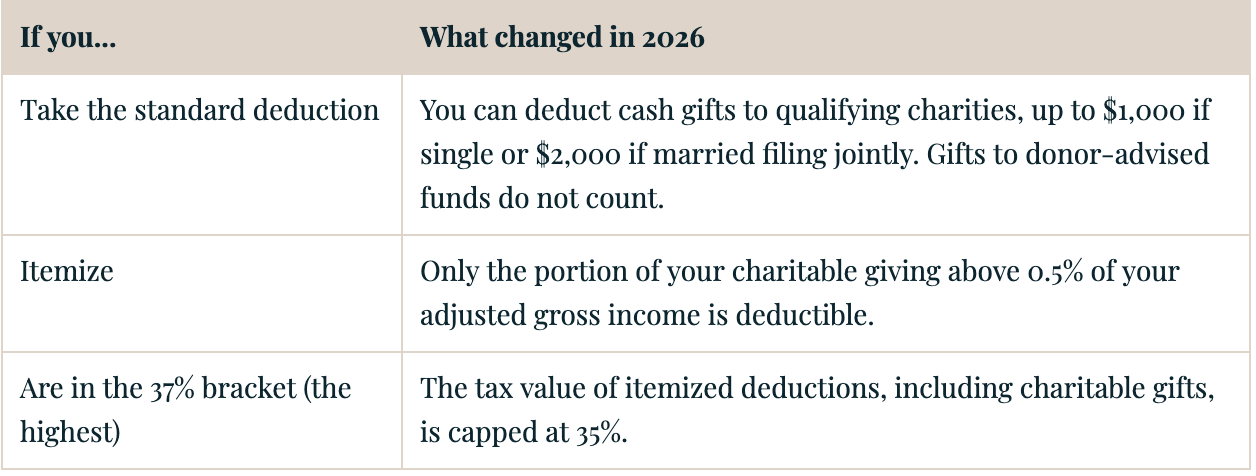
What does this mean in plain words? Giving is now a little more rewarding for people who do not itemize, and a little less rewarding at the very top. For some households, the 0.5% floor makes bunching more attractive than it used to be (see strategy 2).
These rules interact with each other and with the rest of your return. Ask us, or your CPA, how they apply to you before you write the check.
5. Watch the Calendar
A gift has to be complete by December 31 to count for 2026. “Complete” means different things depending on how you give.
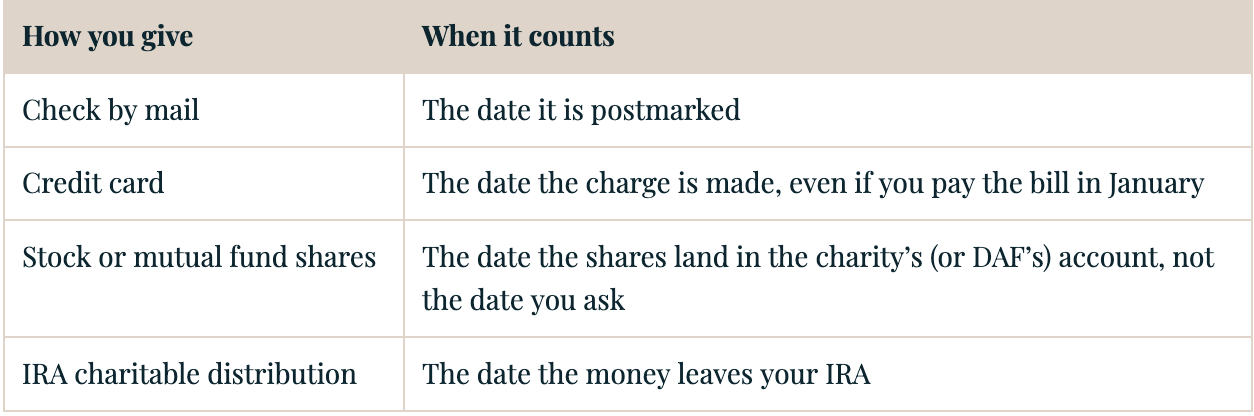
Stock transfers are the ones that sneak up on people. Brokerage firms get busy in December, and mutual fund transfers can take longer still. If you are giving shares, start in November or early December. Do not wait for the last week.
How to Choose: Feelings First, Calculator Second
None of these strategies is a reason to give. They are reasons to give well. Start with the cause that makes you lean in, the one you could not stop thinking about. Then bring the calculator and see how much further your gift can go.
If you would like help deciding which of these fits your situation, that is exactly the kind of conversation we love having at Truman Wealth. We are a fee-only fiduciary firm, which means we are paid by you and only you, never by a product. Book a complimentary 30-minute discovery call.
Keep the fire going.
Live a wealthy life, my friends.
This content is intended for informational and illustrative purposes only and should not be construed as personalized investment, tax, or legal advice. Any hypothetical examples are for illustrative purposes only and do not represent actual client results. Investment advisory services offered through Truman Wealth Advisors, LLC, a registered investment advisor. The firm's ADV Brochure and Form CRS are available, at no charge, on our website https://www.trumanwealthadvisors.com. They include important disclosures and should be read carefully. There is a risk of loss from an investment in securities, including the loss of principal.
Truman Wealth Advisors does not accept any liability for the use of the information discussed. Consult with a qualified financial, legal, or tax professional prior to taking any action. Before investing, consider investment objectives, risks, fees, and expenses. Investments in securities involve the risk of loss, including loss of principal. Past performance is no guarantee of future returns. The views and opinions reflected in the content are subject to change at any time without notice. The content speaks only as of the date indicated. Some information was obtained from external sources. The information is believed to be accurate, but there is no guarantee that it is.
